 BEST Test of English Proficiency - website
Reference Resources for Aligning BESTEP with University English Courses
In 2021, the Ministry of Education (MOE) launched the Program on Bilingual Education for Students in Colleges (BEST), with the aim of equipping university students with adequate English communication skills prior to entering English-medium academic or workplace environments. Underpinned by the alignment of curriculum, pedagogy, and assessment, the MOE funded the LTTC to develop the BEST Test of English Proficiency (BESTEP) to promote positive interaction among assessment, teaching, and learning and further improve students’ English learning effectiveness.
BESTEP is an EAP-oriented (English for Academic Purposes) assessment specifically designed for college and university students in Taiwan. It not only makes reference to Taiwan’s English Curriculum Guidelines of 12-Year Basic Education, EAP in higher education, and the English-Medium Instruction (EMI) environment but is also benchmarked against international language proficiency frameworks (including the Common European Framework of Reference for Languages, CEFR). With these references, BESTEP defines academic English core competency indicators suitable for Taiwan’s higher education and uses them to design test content and assessment tasks.
Building on the principles outlined in Aligning Language Education with the CEFR: A Handbook (ALTE, British Council, EALTA, UKALTA, 2002), the LTTC provides six reference resources* to support EAP courses in aligning their curricula with BESTEP. These resources may also be applied to English for Specific Academic Purposes (ESAP) courses (see below).
EAP and ESAP courses share the goal of preparing students for readiness in future EMI academic environments. EAP builds a foundation of general academic skills that apply across disciplines, while ESAP extends this foundation by incorporating discipline-specific language knowledge and practical application skills. In addition, EAP courses often emphasize general academic skills, such as writing an abstract, using proper citation, and constructing arguments, all of which also serve as the foundation for ESAP.
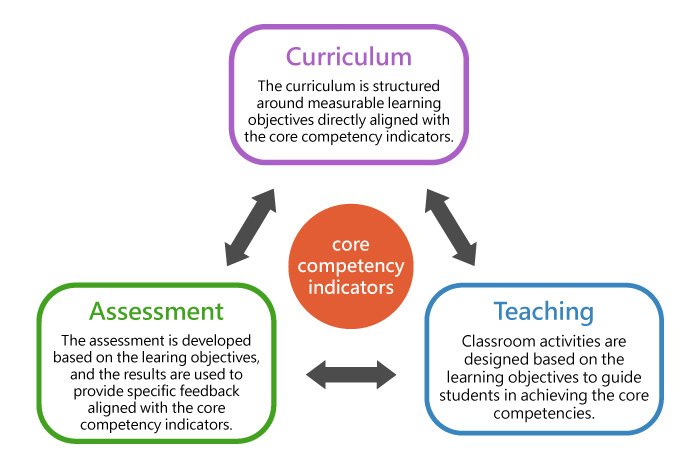
*The six reference resources prepared by the LTTC use the BESTEP can-do descriptors as the core competency indicators to align curriculum, pedagogy, and assessment (see Figure below), ensuring coherence across the three domains:
- Curriculum: Derive measurable learning objectives from the core competency indicators to guide course design.
- Pedagogy: Align instructional activities with the learning objectives to scaffold students’ progressive development of the targeted competencies.
- Assessment: Align assessment tasks with the learning objectives and anchor post-assessment feedback in the core competency indicators to support further learning.
Descriptions of each resource:
| Resources | Descriptions |
|---|---|
1.Process guide for aligning BESTEP with university English courses PDF download PDF download |
Explains the alignment process with visuals and text. |
| 2.Reference table for aligning BESTEP with university English courses PDF download |
Illustrates the matching of existing learning objectives to BESTEP competency indicators with tables. |
| 3.BESTEP reading sample tasks with explanation PDF download |
Illustrates reading can-do descriptors through concrete BESTEP reading tasks. |
| 4.BESTEP listening sample tasks with explanation PDF download / Listening Audio Download |
Illustrates listening can-do descriptors through concrete BESTEP listening tasks. |
| 5.BESTEP writing sample tasks and performance descriptions PDF download |
Illustrates writing can-do descriptors through writing tasks and sample responses from test takers at different levels. |
| 6.BESTEP speaking sample tasks and performance descriptions PDF download / Audio Download for Sample Responses |
Illustrates speaking can-do descriptors through speaking tasks and sample responses from test takers at different levels. |